

Everything Required to Build Custom Software and Bring It to Market
Building your own software product isn’t a single decision — it’s dozens of interconnected ones made over time.
When custom software projects fail — and they fail expensively — it’s rarely because of bad code or a weak idea. It’s because the business owner never had visibility into the decisions that actually mattered.
This guide forms the foundation of our Software Product Operating System (SPOS): a structured way to ensure the major business, technical, and operational decisions involved in building, scaling, maintaining, and eventually selling custom software are visible and intentional over time.
Most businesses should not attempt to build their own software. The failure rate is high, the costs are real, and the risks are often misunderstood. But when done correctly, custom software can be transformative — creating leverage, defensibility, and long-term enterprise value.
If, after reviewing the areas below, you still want to build a software platform for your business or your industry, we’d be glad to help you do it with clarity and discipline.
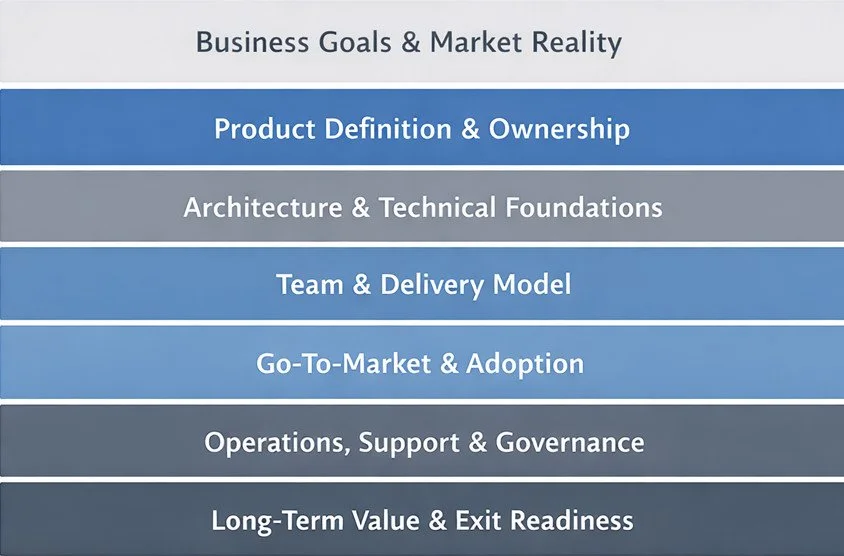
Areas the Software Product Operating System (SPOS) addresses.
Components of the SPOS
The sections below outline the major decision areas that determine whether a custom software initiative succeeds or fails.
You don’t need to solve all of these at once. But you do need to be aware of them — and understand which ones you’re making now, which ones can wait, and which ones are already being made on your behalf. If you’re early, this may feel overwhelming; if you’re mid-build, it may feel uncomfortably familiar.
-
Every software product exists to solve a specific problem for a specific audience.
This includes defining the value proposition, identifying buyer personas, understanding competitive alternatives, and ensuring software meaningfully improves the business model.
Identified Value Proposition
Identified Buyer Personas
Competitive Research
Market Analysis
-
Successful products start with a deliberately constrained scope and evolve over time.
This includes defining the minimum viable feature set, managing tradeoffs, and maintaining a roadmap that reflects capacity and learning.
MVP definition
Rollout strategy (Alpha, Beta, General Availability)
Ongoing roadmap updates
Feature prioritization
-
Software products require ongoing product ownership — even when they begin as internal tools.
This includes deciding who owns the roadmap, how decisions are made, and how feedback is incorporated.
Roadmap ownership
Decision authority
Feedback cycle
-
Early technical decisions shape cost, flexibility, and long-term risk.
This includes technology stacks, integration patterns, and how the system is expected to evolve over time.
Tech stack decisions
Now vs future investments
Integration strategy
-
Where and how software is hosted affects reliability, security, and operating cost.
This includes cloud providers, environment setup, access controls, and operational readiness.
Cloud hosting
Environment setup
IT support
-
Security and reliability must be designed in, not added later.
This includes monitoring, penetration testing, backups, and disaster recovery planning.
Pen testing
Monitoring
Backup & DR plans
Pre-launch testing
-
Software can be built by internal teams, development partners, freelancers, or a mix — and that mix often changes over time.
Each model has tradeoffs related to cost, control, speed, and knowledge retention.
Full-time vs outsourced
Vendor strategy
Staffing evolution
-
Day-to-day execution determines whether progress is predictable and sustainable.
Most teams use some form of agile, but success depends on how it’s applied.
Agile processes
Sprint planning
Capacity planning
-
Launching software requires more than a release date.
This includes defining acquisition strategies, marketing channels, sales motions, and internal alignment.
Sales & marketing strategy
Acquisition plans
GTM playbooks
-
Clear messaging ensures the product can be understood, sold, and supported consistently.
This includes positioning, website content, sales materials, documentation, and training assets.
Messaging framework
Website content
Sales decks
Documentation
Tutorials
-
Launches require coordination across multiple channels and teams.
This includes website launches, email, social media, and public relations.
Website launch
Email campaigns
Social media
PR outreach
Press releases
-
How customers are onboarded shapes adoption and long-term success.
This includes onboarding plans, integrations, data imports, and early support.
Onboarding plans
Data imports
Integrations
Post-launch support
-
Software products improve through feedback and measurement.
This includes defining success metrics, gathering customer feedback, and adjusting the roadmap.
Success metrics
Analytics
Surveys
Retrospectives
Roadmap updates
-
Software requires ongoing care long after launch.
This includes support processes, knowledge bases, and operational reporting.
Service desk
Knowledge base
Support contracts
Reporting
-
Software introduces legal and operational risk that must be addressed deliberately.
This includes user agreements, contracts, insurance, and IP clarity.
Terms of service
Privacy policy
Contracts
Liability insurance
Is This the Right Path for You?
Building custom software is not the right answer for most businesses. The risks are real, the costs compound quickly, and the failure rate is high.
But for businesses with a clear problem, the right discipline, and experienced leadership, software can create leverage, defensibility, and long-term enterprise value.
If you’re considering this path — or already on it and want to regain control — the SPOS provides a way to move forward with clarity and discipline.
We’re here to help you make the right decisions. If that includes building software, we’re here to make sure you succeed.